
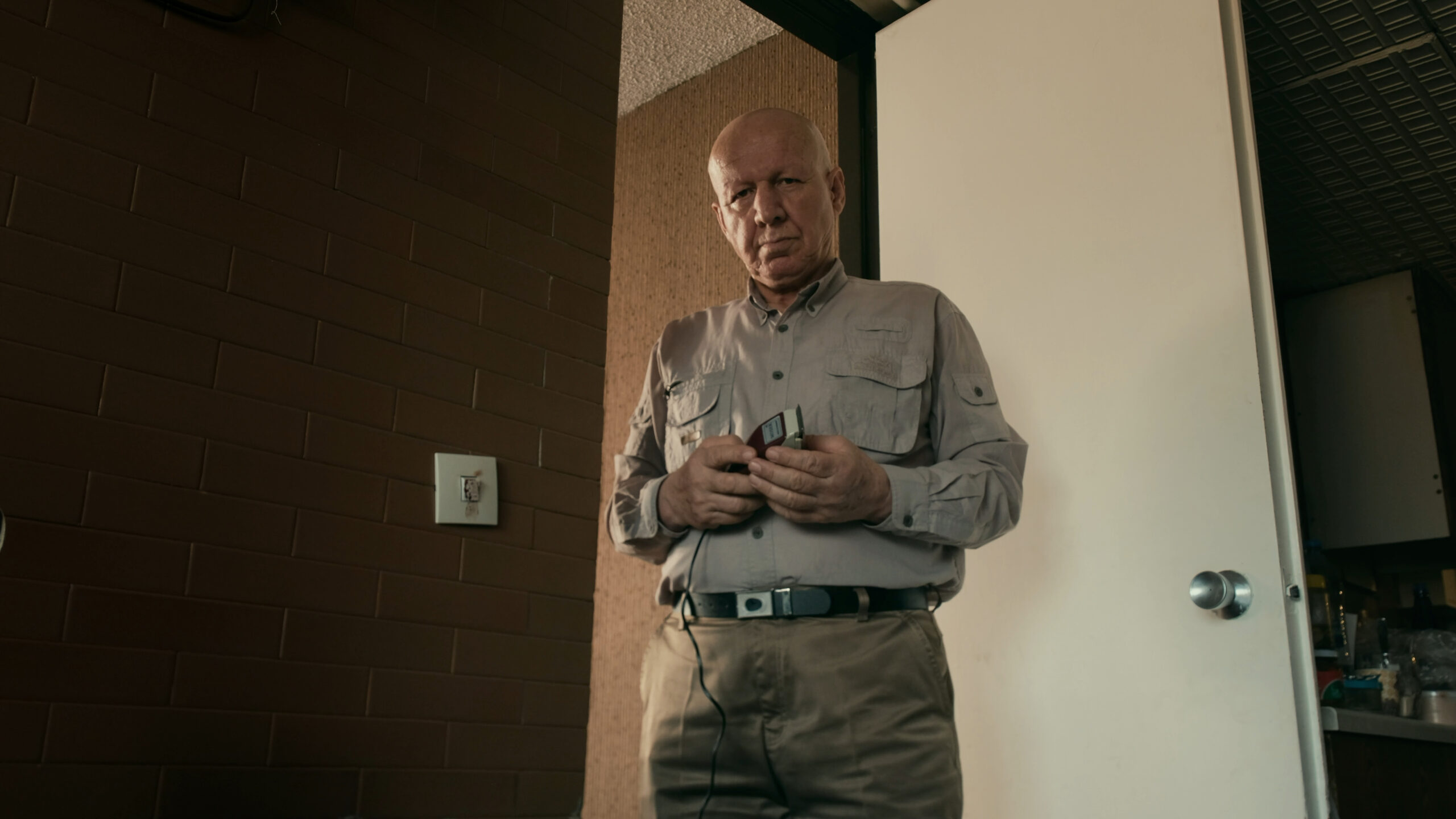

Die Hard Dracula

-
Running Time 88 minutes
-
Genre Dark humor - Comedy - B-movie
-
Language English
-
Completed 31 Dec 1998 - California, USA
When Steven’s girlfriend is abducted by Dracula from a village in Transylvania and imprisoned in his terrible castle, he and vampire hunter Van Helsing must attempt to kill Dracula. Aided by quotable, campy dialog they spoof action movies in their bloody battle royale, climaxing in a shocking ending.


Director and writer Peter Horak may have shot this in Prague and California, but it looks like the kind of movies that Cabellero and VCA put out in 1998 without you know, all the ejaculate. It also has a lead who loses his girl in a rowboat accident, which sends him to Europe, and into the orbit of — you knew it — Dracula (played by three actors, Ernest M. Garcia, Chaba Hrotko and Tom McGowan).

It's basically a retelling of the Dracula story in a modern setting with character actor Bruce Glover as Van Helsing. There's some decent cinematography, fantastic locations in the Czech republic, where this was shot,

I think the biggest problem with this film is that people go into it expecting that it has something to do with the Bruce Willis "Die Hard" series. It's a low-budget vampire film that actually looks pretty good for being low cost. The one innovation in Dracula lore is that he flies in his very unaerodynamic closed coffin. There are multiple problems, such as no one finding it odd that the main character has blue skin, but it has some plot and characterization.


The film opens with quick a prologue we’ve heard thousand times about Vlad The Impaler and his battle against the Turks, as we see images of people literally sitting on poles in their underwear with no blood, no gore, nothing. Not a single attempt to make us believe that we’re looking at tortured and impaled people in a dark middle ages scenario. You’re just a few seconds in, and you already ask why the hell this movie was made and why it even exists. The visuals are just flat out dreadful, and calling it amateurish doesn’t do it justice, it’s even far beyond that. It’s almost a cliché thing to say, but it’s really hard to put words on how ridiculously bad this is. And this is just the first ten seconds or so.

Well, folks, I’m afraid we can put it off no longer: we have finally come to Die Hard Dracula, and hoooboy, what a colossal stinker it is! Those of you hoping for Bruce Willis wearing a cape flying around Nakatomi Plaza are going to be sorely disappointed – although you do get to see a flying coffin! It doesn’t help. Check out the latest episode of Indie Film Cafe with Moody, yer old pal the MooCow, and special returning guest JoLynn (Jo), as they suffer through this 1998 Euro-stinker in the worst way. Technical issue made the sound not so good, sorry, Continuity Monkey is gonna get right on that!

“Die Hard Dracula” is an incompetently made movie on every level. The editing is jerky and feels devoid of continuity, the writing is bizarrely inconsistent in tone, the costumes and makeup are ridiculous, the effects are garbage, and all of the acting is either cartoonishly over-the-top or non-existent.


I regret many decisions in my life and this is one of them. After Dracula Week ended, I could have just skipped this movie and put it off until another month. But no, I just had to watch it for November. Made in 2002 (allegedly 1998), but with production values straight out of the early '90s. This is low-budget crap at it's worst, folks. To make matters worse, a once-good actor is brought down with it: Bruce Glover. Fans of Roger Moore's Bond films will recognize him as one of the two assassins in Diamonds Are Forever. For the rest of you, he's Crispin Glover's dad. Fun fact: the two assassins were actually parodied on Kids Next Door, a show aimed at 10 year-olds. No, I don't get the logic either. Since I can't put off talking about this film any more, let's just get to it. Dracula comes to life and kills people. An American comes by and gets in the middle of the whole situation. I can't stall any longer, so sit down for the pain. Get out your explosive alcohol for my review of...

The things I put up with for the sake of vampires. From the title you know two things, firstly a combination of the Dracula mythos and, yippee-ki-yay, Die Hard (1988) should be a fairly decent combination. A hard action vampire flick with a rich mythology to borrow from. You also know just from the name that it is going to be rubbish.

Among the shoddiest Dracula movies ever made, this looks and sounds a lot like a shot-on-video 1990s porno movie – but without the sex scenes; in fact, it’s less well-made than Out for Blood, Muffy the Vampire Layer or Trampire. Somehow, writer-director Peter Horak – whose other credits are as a stuntman on major studio films from Evel Knievel to Mystery Men – secured locations on two continents (shooting in Prague and California), which means some castles, countrysides and streets look a lot better than the minimal interior sets.


You seldom see such lavish, large-scale locations in a micro-budget film. The incredible antiquity of Prague is evident in the opening sequence.
The Cast! They make a memorable bedroom scene both sensuous and totally hilarious as they go for it in the four-poster. And of course the sexy vampire babes, who go after anything male.
The digital effects spice up the acting, and include Dracula morphing into a bat as well as flying through the air, a la Superman. But the most original effect has to be Dracula spewing lightning from his fingertips. This is too real to be computer generated. It looks great and is a very dangerous stunt to do.
Bought this movie at a 2nd hand store for a $1, so i wasn't expecting too much. But i have to tell you, it was hilarious!!! Why would you be expecting an Oscar winner with a title like this? Come on don't be so serious! The best part was the villagers with the changing accents. "Let's get torches & pitchforks" & then the father more concerned about his daughter being in bed with the guy than her being carried off by the Dracula. The other part everyone enjoyed was the flying coffin with the song of the Valkyrie's for a theme. "The only way to travel" hahaha!!! We watched it with a group of people and maybe that made it better as we had our own running commentary. Would we watch it again.. oh yeah!
it had me thinking "What the h___ is this!". If you're a fan of flicks like "Plan 9......" & "Robot Monster", you'll probably want to see this one.

After losing his girlfriend in a terrible accident, Steve Hillerman (Denny Sachen) moves to a small town that happens to have a vampire outbreak. He teams up with Van Helsing (Bruce Glover)to rid the legendary problem - - Dracula (Ernest Garcia). But, the best laid plans often play into a very good comedy horror. Great film for Halloween.
Have you ever wanted to watch an ultra low budget remake of Dracula starring Crispin Glovers dad as Van Helsing? How about a movie where 3 completely different men, with completely different body types, play the role of Dracula. How about a movie that contains no less than 15 minutes of what seems to be a family vacation footage to Prague? Well if you said yes to any of these questions, or you just love bad movies then this is the film for you.